
Courses & lectures for dentists  |  Referalls (children's dentistry | root canal | orthondontics | implants)  |  dentexcel in the press and media
excellence in cosmetic
and implant dentistry
Call today
020 7636 9393

Dental implants

           
Implant retained denture                    Implant retained bridge                     Single implant and crown

Dr Keith Cohen has over 20 years experience of placing and restoring dental implants and is registered as a Specialist.

He has a particular interest in aesthetic treatments and whole mouth cases which can involve implants with bone and gum grafting and also teaches qualified dentists and postgraduate students in these techniques.

He has received training in Sweden, Switzerland, Germany and England from a number of well-known Professors in these fields. Patients with complex cases and smokers are welcome to come for a consultation.


Advanced Techniques – No Scarring – Bone & Sinus Grafting

At Denexcel we offer advanced Dental Implant techniques, which results in no scarring. We also offer Bone and Sinus Grafting using natural bone available for those who do not want foreign material.

Image: Showing Scarring of the Gum Tissue


What is a dental implant?

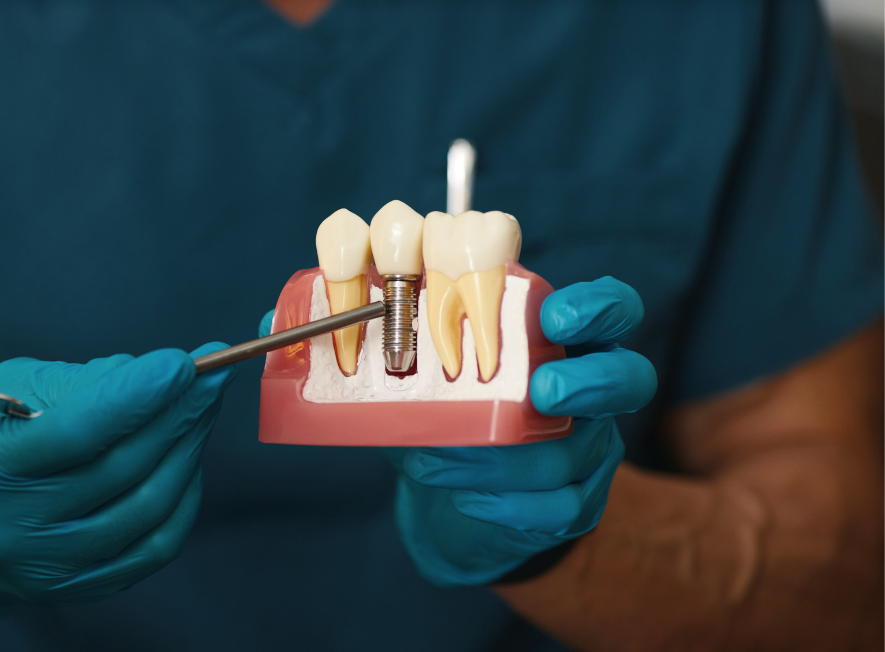
A dental implant is an artificial replacement for the root of a tooth. These are made from titanium which has the unusual property of allowing bone to grow onto its surface. The strong attachment with the bone allows implants to support fixed or removable teeth.

What stages are involved in making a new tooth?

The dental implant is placed in the jaw bone through a small incision.

After a period of 2 to 3 months healing impressions and records are taken to fabricate the restoration to fit on top.


What components make up the implant restoration?

The implant is equivalent to the root of a tooth in the bone.

The crown is the tooth part you see in the mouth.

The abutment is the post which connects the above.

What if I don’t have enough bone?

The gum and bone tend to shrink away once a tooth has been lost, however, new techniques and materials allow these tissues to be replaced.

What is the difference between mini implants and conventional implants?

Mini- implants are thinner and weaker than conventional implants and are particularly useful for stabilising loose dentures or making a temporary fixed restoration during more complex implant treatment.

Dental Implant Cost?

Dental implants cost from £2000 per tooth for straightforward cases.

Where all teeth are missing it is possible to make a restoration on 2 to 6 implants, this means that you do not require one implant for each missing tooth.

Mini- implants cost from £500 each.

See Dental Implant Special Offers>


Sedation

For nervous patients and long treatments we have a medical anaesthetist available to provide sedation.

Teeth in an hour

The latest technology allows us to make a scan of the jaws and transfer this information to an implant guide which then allows placement of implants without lifting the gum.

In addition, new temporary teeth can be prefabricated so that they can be placed immediately on top of the implants – this can even be completed in an hour for some patients.

The advantages are minimal trauma, fast treatment time and immediate fixed teeth.


Experience

Dr Keith Cohen has over 20 years experience of many different types of implant treatment and is registered as a Specialist.

More information about dental implants

There are many reasons why we all occasionally lose a tooth or teeth, and a visit to our cosmetic dentistry practice in London (Harley Street) will see people waiting to see the dentist with problems such as decay, gum disease, or having suffered an accident where a tooth has been knocked out – and requiring an implant. For some people, a visible missing tooth has a devastating effect on confidence, leading to anxiety when smiling or speaking in public. For others with a less visible missing tooth or teeth, the problems of not being able to eat properly can lead to medical problems. Many people do not visit the dentist as regularly as they should and we, along with other London cosmetic dentists, generally only get to see a prospective patient once it is too late to save a tooth. Hopefully, as a reader of the Dentexcel website, you’ll be the exception to this!

As cosmetic dentists we have a number of ways to replace missing teeth such as the fitting of dentures or bridge work, but dental implants are the most effective way to replace missing teeth, and dental implants are the recommended tooth replacement solution of choice. Dental implants offer the only natural replacement for teeth that is comparable to the strength and durability of natural teeth – and are thus considered to be the perfect solution to missing teeth.

As your London cosmetic dentistry practice, we specialise in dental implants and if you ever visit a dentist that does not carry out dental implants himself or herself, they should be able to recommend Dentexcel or an alternative dentist who specialises in dental implants.

What are dental implants?

A dental implant is an artificial tooth root that we as your London dentist would fit into a pre drilled socket in the jaw bone. This holds a replacement tooth or teeth in place and is anchored to the jawbone. One dental implant can support one or more replacement teeth and five or six dental implants are usually enough to replace all the teeth in the jaw. Once the dental implants have been successfully fitted, the teeth will look and feel exactly the same as natural teeth and will require no more care than a normal brushing and flossing routine. As the saying goes: “your smile will be there for life”.

Dental implants are made from titanium, a metallic material that is well tolerated by bone and bone tissue. Titanium has been used by dentists for dental implants since the early 1950s and has proved to be the most successful medium for the process. Titanium dental implants fuse with the natural bone and within a few months will be totally integrated naturally into the mouth. This process called Osseo integration makes a very stable support for the new teeth and one implant can be enough to support up to five or six teeth. Many dental practices in London specialise in fitting dental implants.

Preparing for dental implants

Fitting dental implants is a surgical procedure and before any dental implants can be fitted, as your dentist we will first gives a thorough examination of the mouth. Any gum disease or any other mouth problems must first be treated and the dentist will initially plan the treatment using X rays and in some cases a CT scan to ensure that there is sufficient bone density.

Dental implants have to be inserted by drilling a small hole into the jaw bone so it is important that any anatomical irregularies are noted by the dentist and that the density of the bone can support the procedure beforehand. Once all the checks and scans have been made by the dentist, work can begin. We, like all London dentists, will notify the patient if any underlying health problems are shown up during the procedural checks and will only carry out dental implant work once any other problems have been resolved.

Who is a suitable candidate for dental implants?

Most people are suitable candidates for dental implant surgery, providing they have fully developed jawbone structure and sufficient bone density. In the case of having insufficient bone density, dental implants can still be fitted by the use of extra bone grafting techniques. The dentist will advise on a course of action to resolve other potential problems. Heavy smokers and drinkers who wish to have dental implants and these people will be advised to quit or cut down before dental implants can be fitted as tobacco and alcohol interferes with the dental implant healing process.

Will having dental implants hurt?

As your London cosmetic dentistry practice we will ensure that the process of fitting dental implants is as comfortable to you as possible. Some dental patients feel uneasy in the dentists chair but the dentist will always put the patient at ease and explain the process both beforehand and during the operation. Usually the dental implant procedure can be carried out under simple local anaesthetic – where the patient is fully awake but their mouth is numb, and the dentist can also prescribe a sedative to be taken beforehand if the patient is anxious. In London, dentists sometimes will carry out the work while the patient is under general anaesthetic, but either way the implant proceedure is a relatively painless operation.

The dental implant procedure

The dentist will first cut a small hole into the gum and then drill a hole in the jaw bone. The titanium dental implant is then fitted into the hole and the gum stitched. Once in place, the dental implant is left to heal and begin the process of fusing with the jawbone. The healing and fusing process can take between approximately 6 weeks to 6 or 7 months depending on the individual.. During this time the dentist will give the patient temporary dentures or bridgework to wear so that they can manage throughout the interim period. Throughout this healing period it is important that the temporary teeth, either dental plate or bridgework do not press or exert any force upon the new dental implants. As your dentis we will ensure that the new dental implants can be left to adjust naturally and that the bone tissue can grow and anchor itself into the microscopic surface of the implant. Once the mouth has healed the dentist will then be able to fit the replacement teeth onto the implant. The dentist will ensure that the replacement teeth fit perfectly and comfortably and match the mouth and existing teeth. Fitting dental implants is a highly skilled operation and not all dentists can undertake the work. We, unlike many London dentists, specialise in dental implants and it can be seen as being both a medical and cosmetic process, both of which are equally important to the patient.

Why choose dental implants?

One reason for choosing dental implants over other tooth replacement solutions is that of simple aesthetic appearance. As London cosmetic dentists we understand the need for people to feel confident and look their best in a competive world and dental implants are the best medical and cosmetic solution to tooth loss. When fitting dental implants, the dentist can ensure that the replacement teeth blend in exactly with existing teeth. The immediate effect is totally natural allowing a confident smile with no worrying side issues about avoiding certain food or the dangers of the teeth slipping or looking artificial. After all the best advertisement for any London dentist such as Dentexcel is to have someone walk out of their dental surgery with perfect natural looking teeth! Dental implants also have long lasting benefits. If many teeth are missing, over time the jawbone can experience shrinkage and this will result in facial features that look shrunken and less attractive because of the bone loss. This effect is often seen in people who have worn dentures for many years. The dental implants replicate the natural function of bone tooth roots and keep the aging face more fully formed and attractive.

The advantages of dental implants over other means

Dental plates or dentures can often look slightly false and can click and slip and look unnatural if they do not blend perfectly with the gums. Due to the shape of the face changing over the years, especially if many teeth have been removed, the dentist will need to change the dentures every few years in order to keep the teeth looking natural. This will lead to more visits to the dentist and result in more expense in the future.

Another alternative tooth loss replacement solution (other than dental implants) is bridgework. When replacing missing teeth with dental bridges, the teeth next to the gap need to be prepared by the dentist and otherwise healthy tooth structure removed so that a crown or bridge can fit over the top of the tooth. If one of the supporting teeth is later damaged, the entire bridge restoration will have to be done again resulting in more costly and time consuming visits to the dentist. Conventional bridgework again does nothing to address the problem of natural tooth loss. The final solution to tooth loss is just to leave the space in the mouth but for most people this is not an option that they willingly will choose. Difficulties of eating and chewing food and the appearance of an unsightly gap does not make this a viable long term option for most people, and so furthers the case for dental implants.

How long should a dental implant last?

Dental implants should last a lifetime if normal dental hygiene is practiced. Simple good practice of cleaning the teeth, flossing and dental check ups should ensure that the dental implant will last as long as a natural tooth.

The cost of dental implants

The costs of dental implants vary from dentist to dentist but and all London dentists have a different price structure – but at Dentexcel we are unrivalled at providing the best quality and the most cost effective dental implants

In the long term Dentexcel, as well as most other London dentists, recommend that dental implants will provide the best and most cost effective and efficient solution to tooth loss.